
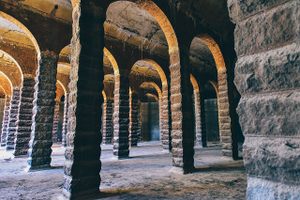
In December 2020, demolition work atop Bishop Hill in Shek Kip Mei district uncovered the long forgotten Sham Shui Po Service Reservoir. Upon breaching the roof, the reservoir’s beautiful Romanesque arches and brickwork were exposed to the general public for the first time in many decades.
The reservoir was built in 1904 as part of the British colonial government’s scheme to provide clean water to Kowloon’s rapidly surging population. The service reservoir’s circular shape maximized the water storage capacity at 9,900 cubic meters, while 108 neatly ordered Roman-style granite masonry piers supported the enclosing concrete roof, which prevented external contamination, but also shrouded this architectural marvel from the eyes of the general public.
The service reservoir continued to provide clean water to the surrounding districts until being decommissioned in 1970. Completion of the Shek Kip Mei Fresh Water Service Reservoir, with a ten times larger storage capacity, rendered the long serving Bishop Hill Reservoir obsolete and largely forgotten with the passage of time.
The demolition work that uncovered the Reservoir was part of routine renovations by the Water Services Department. Media and public upon the site’s discovery led to the Water Services Department suspending demolition, while the Antiquities Advisory Board evaluated the site’s historical value. Ultimately, the reservoir was awarded an all-protecting Grade 1 historic structure status.
Today, the Sham Shui Po Reservoir has been thoughtfully repurposed as a visitor attraction. A steel and glass roof structure provides shelter from the elements, but still allows natural light into the interior of the previously sealed reservoir. As visitors circle the chamber, yellow lighting illuminates the mesmerizing semi-circular arches, brickwork, and concrete cove ceilings.