
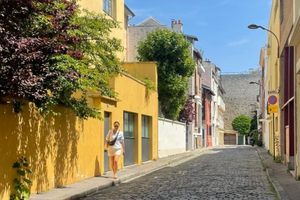
In Paris, the 14th arrondissement is rarely visited by tourists. Yet many places there are worth a visit. The Villa Seurat is one of them.
Contrary to what its name might suggest, it is not a large and luxurious country house, because in Paris, the term “villa” refers to a street or cul-de-sac lined with individual houses.
This one was built between 1920 and 1926 on land that had previously been used for stables and sheds. It is named after the painter Georges Seurat, inventor of pointillism, and is unique in that it houses several studios that were designed from the outset for artists.
The villa—and the eight artists’ studios it contains—was designed by architect André Lurçat, who was commissioned by his artist friends.
Architecturally, the studios he designed for this villa are characterized by : large bay windows to let in light ; high ceilings for working in good conditions, especially for sculpture ; a fairly minimalist modernist style that highlights raw materials such as reinforced concrete, cement, and bricks.
Salvador Dali and his muse Gala lived at No. 1 between 1932 and 1934. It was here that he painted his painting The Enigma of William Tell.
At No. 7 is the house of the sculptor Chana Orloff. It is worth noting that on the ground floor, the double-height studio opens onto large wooden doors that allowed the large blocks of stone used by the artist to be brought in.
At No. 18, Henry Miller began writing his novel Tropic of Cancer in 1931, which was published in 1934 (and banned in France until 1964).
Beyond its history, this dead-end street is worth a visit for its charm, especially in spring when it’s bursting with flowers. After exploring it, you can continue your stroll in the Parc Montsouris, which is right next door.