
Listen and subscribe on Apple Podcasts, Spotify, and all major podcast apps.
Elah Feder: Johanna, do you ever buy lottery tickets?
Johanna Mayer: No, never. Not a lottery ticket kind of gal.
Elah: I actually just got shamed by the man selling me lottery tickets for wasting my money.
Johanna: You buy lottery tickets?
Elah: I do buy lottery tickets. And I think what I really like about it is fantasizing that, you know, if I have enough money, I will finally be able to do whatever I want.
Johanna: And this is the appeal of being a multimillionaire, Elah.
Elah: Right, right.
Johanna: You’re not the first one to have this impulse.
Elah: I have this crazy, wild notion that money will give me power. And the story that we’re going to talk about today is about a lot of things. But one of them is a lesson about how even with unlimited money, from time to time, the world refuses to do your bidding. So I want to take you back to the 1920s and tell you about Henry Ford. The 1920s was a time when Henry Ford was incredibly wealthy. Classic story. He started off as a simple Michigan farm boy, started tinkering. And then in 1908, he created the Model T, the first ever affordable mass-produced car, which made him incredibly rich. But it also reshaped America in the process. He decided that well-paid workers weren’t going to quit, so he brought in higher wages. He also brought in the eight-hour workday.
Johanna: It’s funny, I was just talking last weekend with my partner about Ford a little bit, where we were like, he is the reason that we have a car-centric society. But he was surprisingly good to his workers. Complicated figure.
Elah: He started off good to his workers. We’ll get there. But in the late 1920s, Ford, despite all of his wealth, he was forced to cave on a couple of pretty big things. He was forced to finally update his cars after years of resisting even a simple color change. Even more humiliating, a defamation suit forced him to apologize to Jewish people, which was very difficult for him because he loved talking about Jews before that. So in the late ’20s, Ford was realizing he was not all-powerful. But then in 1927, an incredible opportunity presented itself. A real chance to enact his vision of society, maybe without having to compromise this time. It was a place called Fordlândia in Brazil. And it didn’t quite make the biography on the Ford website for reasons that I think will soon become clear.
I’m Johanna Mayer, and this is Atlas Obscura.
And I’m Elah Feder. And today, the story of Fordlândia, Henry Ford’s attempt to build a wholesome Midwestern town in the Amazon rainforest.
This is an edited transcript of the Atlas Obscura Podcast: a celebration of the world’s strange, incredible, and wondrous places. Find the show on Apple Podcasts, Spotify, and all major podcast apps.
Johanna: Okay, I am intrigued. Why the rainforest? Why did Ford decide to build his vision of utopia in the Amazon rainforest?
Elah: So, it didn’t start out with a town. It started with rubber. So, as you know, cars need rubber for tires, for hoses. Today, most rubber is synthetic. The 1920s, it pretty much all came from rubber trees.
Johanna: So I did know this, and I can picture a rubber tree, which I think has a lot of big roots and like a wide trunk and stuff.
Elah: Massive.
Johanna: But I have never understood exactly how you get rubber from these trees.
Elah: It’s not too complicated. Ancient Mesoamericans figured this out. All you need to do is injure the tree.
Johanna: It saps it out?
Elah: It’s not technically sap. It’s another substance that oozes out of the tree. It kind of looks like coconut milk. It’s sticky and white and full of defense compounds. And that substance is called latex. So if you peel the bark of a rubber tree and let the latex drip out into a bucket, and then you dry it out, you get this bendy, bouncy material that we call rubber. So Ford decides he’s going to grow these rubber trees where they came from: the Amazon rainforest in Brazil.
Johanna: Seems like a solid plan.
Elah: It does seem that way. I should say it wasn’t actually Ford’s idea. He was actually being courted pretty aggressively by Brazilians. There was a Brazilian diplomat who really wanted to bring Ford to Brazil. There was a wealthy Brazilian businessman. And the idea was that bringing Ford, this wealthy industrialist, could potentially revive a really impoverished region, the northeast of Brazil.
Ford very quickly agreed, and the company acquired 2.5 million acres of land, which they called Fordlândia. So, Fordlândia was on the east side of the Tapajos River, which is a tributary of the Amazon. This land is really deep in the rainforest. There were no roads, no railways. It took about 18 hours by boat to get there from the nearest city.
So just imagine your classic kind of jungle. Towering trees, thick vines, tons of insects, birds, thousands of species, and, of course, rubber trees.
Johanna: Okay, goal is to create a rubber plantation. Makes sense to go to the Amazon. The part that I’m snagging on is the Midwestern town aspect.
Elah: Right.
Johanna: How does that come in?
Elah: So, a plantation obviously doesn’t run itself. It needs people. You need people to tap the trees, harvest the rubber. And then you need other people to feed those people, provide medical care. If you have families coming with the workers, then you’re going to need schools. You might need entertainment. You really need a whole town.
And at Fordlândia, that’s what Ford created. Although not Ford himself, Ford didn’t go to Brazil. He had a crew of Ford company men who were dedicated to making this place according to Henry Ford’s vision.
Johanna: It’s how it usually goes.
Elah: So the town itself, it took a little bit of time to build. People started showing up well before there was a town. People who needed work came, and they brought their families. So they needed a place to live. They slapped together temporary shelters using planks from packing crates for walls and palm leaves for roofs.
But within a couple of years, there was the start of a recognizable American-style town. They had a power plant, a hospital, a neighborhood with wooden houses with sidewalks and street lamps. A little later would come tennis courts, a dance hall, a movie theater, a golf course.
But this was not just a lovely oasis in the Amazon. Because Henry Ford was a man with very particular ideas about how a society should be run. So increasingly, as he got older, he had this nostalgia for his old pastoral life. But at the same time, he hated cows.
Johanna: What’s wrong with cows?
Elah: Well, he thought they were very crude and inefficient machines. And he thought—
Johanna: Was—
Elah: Sorry, go ahead. I don’t think he was vegetarian.
Johanna: That’s what I was going to ask, yeah.
Elah: But he was a big fan of soy.
Johanna: Okay.
Elah: One time he built a full soy body. He had a suit made out of soy fibers.
Johanna: This is a whole other podcast episode.
Elah: The cow thing kind of threw me for a loop. But some of his ideas were actually really good. Like we mentioned, he thought people should be well paid, shouldn’t work super long hours. He also thought it was important that people be healthy. So he didn’t think they should drink or smoke. But he took this wholesome lifestyle thing a little far. He thought, for example, that dancing was good, but should not involve too much touching.
Johanna: No sexy dancing allowed.
Elah: Yes. Too many people were sexy dancing, which he blamed on Jewish people. So …
Johanna: What?
Elah: You’re welcome for that. I’m sure a lot of us have our own idiosyncratic spin on what makes a good life. The difference between Henry Ford and most of us is that he actually had the power to make his vision happen, to fashion a world in his image. This is not necessarily a good power for everyone to have.
Henry Ford didn’t just encourage good habits and provide healthy food to his workers. He forced these things on them, not just in Fordlândia, but in all of his facilities. But as you can imagine, workers in the Amazon did not get the royal treatment.
They were supposed to eat Henry Ford prescribed healthy meals at the company mess hall. They had to report any sexually transmitted infections to the company or risk getting caught at random STI inspections. They were not allowed to drink. A team of men would actually do spot searches of people’s homes and confiscate any alcohol that they found.
Johanna: It strikes me that this may not be the best route to creating the utopian society that you desire. The difference between Ford’s utopian society, Fordlândia, and a lot of other ones that come up throughout history is that in other utopian societies, people are signing up. They’re actively joining them of their own volition because they supposedly believe in some sort of common vision. Not the case here.
Elah: People just came to make rubber and get a paycheck. They did not come to have every aspect of their lives controlled. There were also unique challenges in the Amazon that Ford’s men did not anticipate. It turns out that you cannot just build an American town exactly as it is in America, wherever you want.
Johanna: Wait, you can’t?
Elah: Yeah. Revise life plan. For example, the houses that they had built. People were used to these houses with dirt floors and thatched roofs. These new houses had concrete floors and metal roofs. It impressed the journalists that visited, but they were unbearably hot in this climate. You do not want to be cooking under a metal roof, and you want good airflow. The Ford company provided free medical care for the workers, at least.
Johanna: Sounds good.
Elah: Despite that, a lot of people died. It is hard going in the Amazon. Both the American families and the Brazilian workers, a lot of people died of tropical diseases. People were being bitten by vipers when they were trying to clear jungle. This one guy whose job was to saw timber, he ended up preparing a lot of the wood they needed for coffins. He estimated they were averaging a death a day.
In 1930, so just two years into the project, frustrations were at an all-time high. Ford’s men were also realizing that they weren’t really doing a good job of keeping people in line. In December of that year, 1930, one of Ford’s officials decides they need to make a change. Ford, as you know, wanted people to eat healthy. Apparently, he prescribed that people eat oatmeal and canned peaches for breakfast.
Johanna: That sounds good.
Elah: And rice and whole wheat bread for dinner. But—
Johanna: Sounds less good.
Elah: People wanted to eat whatever they wanted. And so they were getting food elsewhere. And this Ford employee decided that the solution was to feed them food from the cafeteria and deduct it from their wages.
And that is when people snapped. It started when a guy named Manuel Caetano de Jesus, who was a brick mason, he decided to confront a payroll worker in the dining hall. And Manuel was yelling at him in Portuguese, which apparently this guy did not understand. But then Manuel hands him his badge, which he did understand. And this payroll worker’s reaction is to laugh.
And that’s when the whole place erupts. People are suddenly smashing plates, pots, sinks, and they go and find all the Ford cars and smash them up. According to one person who was there, people started chanting “Brazil for Brazilians, kill all the Americans.” This was a massive riot across Fordlândia. And by the time that things calm down, the place is basically in ruins.
Johanna: Is that it? Is that the end of Fordlândia?
Elah: Weirdly not. Somehow.
Johanna: Incredible.
Elah: Yeah. So they end up firing most of the workers, but keep a skeleton crew and start to rebuild. And a few years later, they end up acquiring another plot of land nearby and building a second town and more plantations. And Fordlândia chugs along. The bigger problem, at least for the Ford company, is not that the workers hate them. It’s that Fordlândia isn’t actually doing the one thing it’s supposed to do, which is produce rubber.
Johanna: God, this has been such a journey, I forgot that they were supposed to be producing rubber this whole time.
Elah: That was the point of all of this. So it does take time, right? And they’d had many false starts. You know, they planted trees in the dry season. That didn’t work well. But eventually they get it together. And by 1940, they have three million trees planted across 30,000 acres of land.
Johanna: Whoa.
Elah: But here’s the thing. It turns out Brazil is not actually the best place to grow Brazilian rubber trees.
Johanna: What?
Elah: Because Brazil, the place the trees are native to, also has all of the trees’ natural enemies.
Johanna: Ah, interesting.
Elah: When trees are scattered throughout a forest, the trees manage to grow okay. But then imagine you are a rubber tree-eating bug or fungus, and you come upon all of these rubber trees jam-packed together in one place. You are going to come out and feast. You’re going to reproduce. You’re going to hop from tree to tree. It’s a massive buffet.
Johanna: Like, here we are!
Elah: Yeah. So by 1940, 70 percent of Fordlândia’s rubber trees were infected with a fungal blight. They get through that. But then in 1942, they’re hit with caterpillars.
Johanna: Dun, dun, dun.
Elah: I mean, caterpillars had always been a problem. But for a few years, the workers managed to keep them at bay. But in 1942, there is a total caterpillar explosion that they just can’t keep up with. And just as the situation was starting to get under control, they were hit with a second wave of fungal blight. And combined, it’s a pretty fatal blow. And just a few years later, in November of 1945, the company decides it is time to abandon this project. Apparently, they did not give the local workers much notice. Many Brazilians didn’t even know the Americans were leaving until the day they got on the ships. And that was how they found out they were unemployed.
Johanna: Oh, my God.
Elah: Yeah. By this point, Ford himself was over 80. He wasn’t doing well. And two years later, he died.
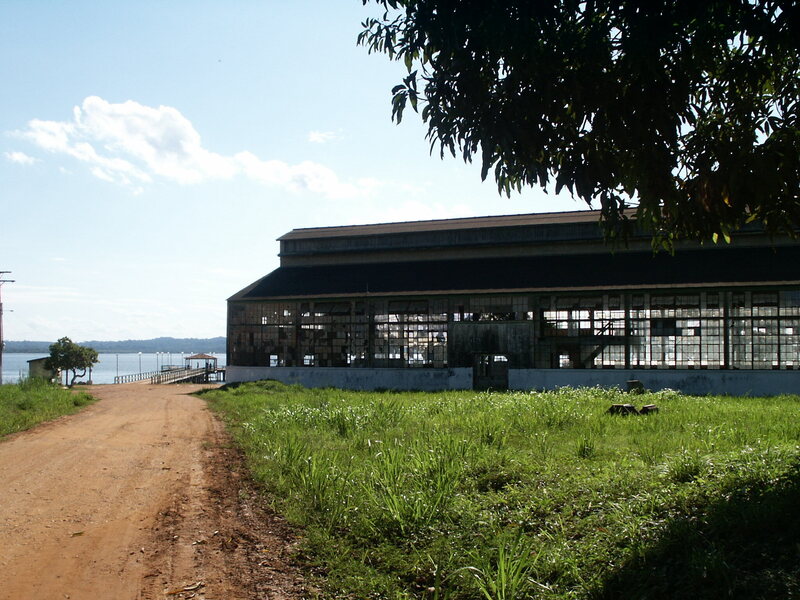
Johanna: You said that they just picked up and left and got on ships. What happened to the town? Are the buildings still there? Does anyone still live there? What happened to Fordlândia? Elah: So a lot of the story I’ve told you is based on a book by Greg Grandin called Fordlandia, which came out in 2009. When he visited, a lot of the old structures were there. The old factory buildings, the sawmill, the warehouse, they’re kind of falling apart but standing. And a few of the old houses were there, too, apparently full of bats and just covered in guano.
And back when Greg Grandin visited, one of the main sources of income was cattle ranching. Apparently, there were cows grazing on the old golf course. The old tennis courts had been turned into cattle stalls. And the hillsides that used to be planted with rubber trees were turned into pasture land for cows.
Johanna: Yes, justice for the cows. This was a totally fascinating story, Elah. Thank you.
Elah: Thanks for having me, Johanna. The town of Fordlândia is still around. And since Greg Grandin’s visit, it’s had a bit of a resurgence. An estimated 3,000 people live there. There’s now a tall Catholic church, a guest house, a bar, a restaurant. And scattered throughout, crumbling remains of Henry Ford’s failed American town.
Listen and subscribe on Apple Podcasts, Spotify, and all major podcast apps.
Our podcast is a co-production of Atlas Obscura and Stitcher Studios. The people who make our show include Dylan Thuras, Doug Baldinger, Kameel Stanley, Johanna Mayer, Manolo Morales, Amanda McGowan, Alexa Lim, Casey Holford, and Luz Fleming. Our theme music is by Sam Tyndall.